In November 2025, Vaca Muerta reached a historical record: 578,461 daily barrels of oil, a growth of 30.68% compared to the previous year. The Patagonian formation now provides 62% of the national crude oil production and 74% of the country's natural gas. Committed investments for the next decade exceed USD 125 billion, including a USD 36 billion program by YPF alone.
The problem is that all this energy is extracted in remote locations of Neuquén and Río Negro, hundreds of kilometers from the power grid. And the camps, monitoring wells, compressors, control valves, and communication systems that support this production need electricity 24 hours a day, 365 days a year.
The industry's historical response was always the same: diesel generators. The response that is replacing it is another: off-grid systems with solar generation and high-capacity storage.
The true cost of diesel in an oil field
When calculating the cost of diesel energy in a remote site, fuel price is only part of the equation. The real cost includes logistics, storage, generator maintenance, and—most underestimated—the operational risk of a supply chain that can be cut off.
| Cost Component | Reference (per kWh generated) |
|---|---|
| Diesel fuel (wellhead price) | USD 0.28 – 0.40 |
| Logistics and freight to remote location | USD 0.08 – 0.18 |
| Generator set maintenance | USD 0.04 – 0.09 |
| On-site storage (tanks, security) | USD 0.02 – 0.05 |
| Estimated total cost per kWh | USD 0.42 – 0.72 |
* 2025 reference for locations in Neuquén and Río Negro with seasonal road access. Values vary depending on distance, season, and type of operation.
A base camp with an average continuous consumption of 50 kW consumes around 438,000 kWh per year. At a conservative cost of USD 0.50/kWh, that equates to USD 219,000 annually in diesel fuel alone, not counting interruptions, contingencies, or the environmental impact of a system that emits an average of 0.65 kg of CO₂ per generated kWh.
"Every tank truck that does not reach the location is potentially a shut-down well. Diesel is not an energy solution for the new Vaca Muerta: it is an operational constraint that the sector is beginning to resolve."
Why the power grid does not reach (and will not arrive soon)
The Argentine high-voltage grid has a coverage designed for demand concentrations: cities, industrial parks, agribusiness. Vaca Muerta's expansion occurred in a territory where electrical infrastructure simply did not exist, and where extending it has a cost that is not always justified for a production location with a limited useful life.
Tending high-voltage lines in the Patagonian desert costs between USD 80,000 and USD 200,000 per kilometer depending on the terrain and required power. For a well 150 km from the nearest substation, that can represent an investment of USD 12 to 30 million to supply a single location during the 20 years of its productive life.
In this context, energy autonomy is not an aspirational option: it is the only engineering that makes economic sense.
The solution: autonomous energy shelter
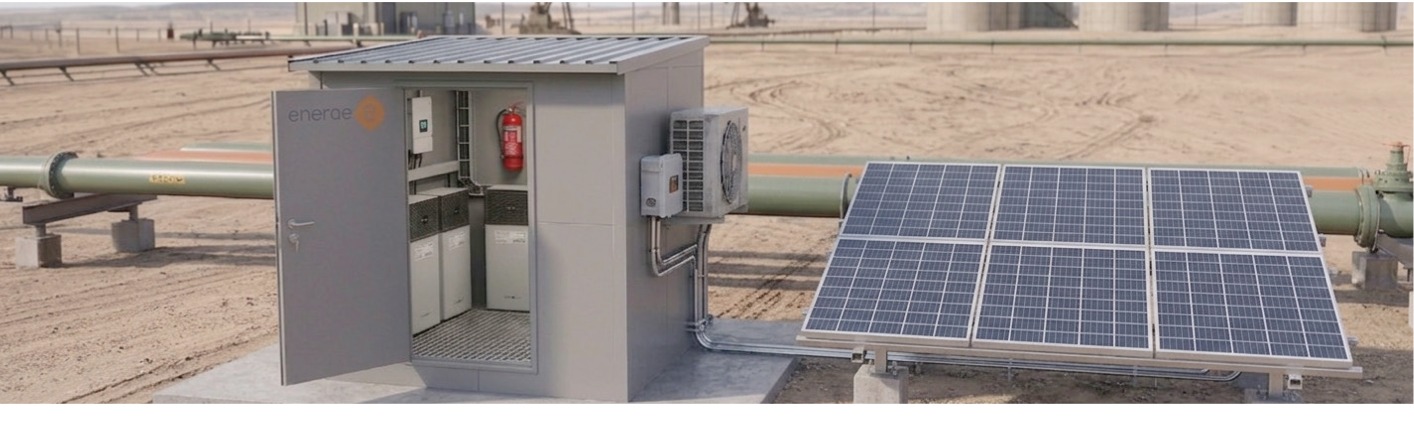
The answer that the market is adopting—and that Energe designs and deploys in Argentina—is an integrated system of photovoltaic solar generation and high-capacity electrochemical storage, encapsulated in a transportable climatized shelter that can be installed and operate in any location in the country in less than 48 hours.
The system resolves the three core problems of diesel supply:
- Logistical independence: once installed, it does not require replenishment. Panels generate during the day and LiFePO4 batteries sustain operation at night or on cloudy days.
- Operational reliability: with no moving parts in the generation system and batteries guaranteed for more than 8,000 cycles, the uptime exceeds 99.5%.
- Zero emissions on-site: eliminates fuel burning and allows companies to report their remote locations within their ESG decarbonization strategy.
Technical specifications of the standard system
| Component | Specification |
|---|---|
| Solar generation | 5 kWp base (8 panels of 625 Wp) — scalable to 10 kWp |
| Storage | 128 kWh LiFePO4 — 8× Pylontech Fidus Plus 16 kWh |
| Hybrid inverter | Deye SUN-10K — 10 kW three-phase, unbalanced loads |
| Shelter | 2.0 × 2.0 × 2.2 m climatized — sandwich insulation |
| Climatization | Industrial air conditioning + backup heater |
| Safety | Aerosol module extinction, manual CO₂, thermal alarm |
| Monitoring | Real-time via app and web portal — state of charge, generation, and alerts |
| Protection | IP65 — suitable for extreme climates: desert, altitude, Patagonian wind |
| Autonomy without sun | 2 to 4 days depending on location consumption |
| Deployment | No civil works — transport by truck, operational in 48 hours |
Cost comparison: diesel vs solar off-grid
For a location with an average continuous consumption of 30 kW (264,000 kWh/year), the financial analysis over 10 years is decisive:
| Concept | Diesel system | Solar off-grid system |
|---|---|---|
| Initial investment | USD 45,000 (2 generator sets) | USD 95,000 (shelter + panels + batteries) |
| Annual operating cost | USD 132,000 – 190,000 | USD 3,500 – 6,000 |
| Total cost at 10 years | USD 1,365,000 – 1,945,000 | USD 130,000 – 155,000 |
| Solar system payback | — | 9 to 14 months |
| CO₂ emissions (10 years) | ~1,716 tons | ~0 tons on-site |
* 2025-2026 reference values. Diesel cost includes estimated freight for locations in the Neuquén basin more than 100 km from paved roads. Solar payback varies according to radiation and consumption profile.
Concrete applications in the extractive industry
Off-grid systems are not only useful for the base camp. Along the productive chain of a field, there are dozens of consumption points that currently depend on diesel or costly power extensions:
- Wellheads and manifolds: instrumentation, RTUs, PLCs, and control valves requiring continuous 24V or 48V DC supply.
- Minor compression stations: low-power compressors for pressure maintenance in gathering gas pipelines.
- Guard and drilling camps: lighting, communications, HVAC, and equipment charging in locations without grid access.
- Produced water treatment systems: pumps, aerators, and continuous monitoring systems in evaporation ponds.
- Custody transfer stations: flowmeters, chromatographs, and SCADA systems requiring uninterrupted power with integrated UPS.
- Communication towers and repeaters: radio and fiber optic nodes on high points without regular vehicular access.
Vaca Muerta, mining, and RIGI as a lever
The Incentive Regime for Large Investments (RIGI) approved in 2024 already has more than 20 approved projects for USD 30 billion as of September 30, 2025. The majority involves infrastructure development in Vaca Muerta and mining sectors in Neuquén, Salta, San Juan, and Jujuy.
This context opens a relevant window: RIGI projects incorporating renewable generation components can access additional tax benefits and accelerated depreciation. A solar off-grid system qualifies as an investment in energy efficiency and emissions reduction, positioning it within the ESG chapters that the international sponsors of these projects demand by contract.
In parallel, Argentine mining—especially lithium in the NOA region and copper in San Juan—is going through a similar expansion cycle. Lithium fields in the Puna are at altitudes of 3,500 to 4,500 meters above sea level, where the electrical grid also does not reach and the conditions for diesel generators (temperature, altitude, wind) are extreme. The solar off-grid system with LiFePO4 storage operates with equal efficiency at 4,000 meters above sea level as it does at sea level.
The ESG argument that is no longer optional
The major operators of Vaca Muerta—YPF, TotalEnergies, Shell, Tecpetrol, Pan American Energy—have public decarbonization commitments aligned with the international agreements their parent companies signed. Operating with diesel in locations that could be supplied with solar creates growing exposure in Scope 1 and Scope 2 emissions reports.
Replacing diesel generation with solar off-grid systems allows operators to eliminate between 150 and 400 tons of CO₂ per year per location, depending on consumption. As carbon markets mature in Argentina—with the ETS under discussion since 2023—this reduction can have a direct monetary value in addition to operational savings.
"The off-grid system is no longer just cheap energy. It is the asset that allows a company to prove that its productive expansion and climate strategy are not contradictory."
Why the moment is now
Three factors converge to make 2025-2026 the optimal time to incorporate off-grid systems in remote operations:
- The price of LiFePO4 batteries fell 65% in five years. Systems that in 2019 had a 6-8 year payback now have it at 9-18 months in locations with significant diesel consumption.
- Local deployment capacity exists. It is no longer necessary to import the complete system or wait months for an installation: Energe manufactures, integrates, and commissions in Argentina, with local technical support.
- The opportunity cost grows. Each month of diesel operation in a location that could be solar is a quantifiable loss. With the level of activity projected for Vaca Muerta over the next decade, that cumulative cost is significant.
Conclusion
Vaca Muerta represents the largest energy value generation opportunity in recent Argentine history. But sustaining that growth with diesel infrastructure in remote locations is not only expensive: it is a decision that in the medium term becomes financially, operationally, and regulatorily unsustainable.
Off-grid systems with solar generation and high-capacity storage are not a future promise: they are proven technology, with costs that already beat diesel economics and with the capacity to deploy to any point in Patagonia or the Puna in 48 hours.
If your company operates or plans to operate in remote locations—oil, gas, mining, or critical infrastructure—the time to evaluate the transition is before committing another year of diesel supply contracts.